Teeth don't slide through bone. Your body actively removes bone in their path. Builds new bone behind them. Voluntarily. In response to a few grams of pressure from a wire or a piece of clear plastic.
This is why orthodontics works at all. It's also why most people who finish treatment but stop wearing their retainer end up watching their results unravel.
The orthodontist is choreographing your biology, not bending metal. Understanding what's actually happening helps you make sharper decisions about treatment, retention, and whether the cheapest quote you got is going to leave you with a permanent result or a temporary one.
How a tooth actually moves through bone
Your tooth sits in a socket. Between the tooth root and the bone is a thin layer of fibrous tissue called the periodontal ligament. The PDL is a shock absorber. It's also where every signal that triggers tooth movement starts.
When a brace or aligner pushes against a tooth, the PDL gets squeezed on one side and stretched on the other.
On the squeezed side, your body sends osteoclasts. These cells dissolve bone, clearing space for the tooth to move into.
On the stretched side, osteoblasts arrive. They build new bone, filling the gap behind the moving tooth so it locks into its new position.
This isn't a metaphor. Your jawbone is being remodeled in real time, weekly, for the entire length of your treatment. The visible part (the brackets, the trays) is the easy part. The biology is doing the heavy lifting.
Why pressing harder doesn't speed treatment up
It seems intuitive that more force should move teeth faster. The opposite is true.
When force on a tooth gets too heavy, the blood vessels inside the periodontal ligament get completely compressed. Blood supply to the area cuts off. The tissue goes into a state called hyalinization, a kind of localized cellular shutdown.
Tooth movement stops.
Your body now has to recruit cells from deeper in the bone to clear out the damaged tissue before movement can restart. This is why a treatment plan built on aggressive force and a faster timeline actually takes longer than one built on light continuous force.
Your orthodontist isn't being cautious when they prescribe gentle pressure. They're using the only level of force that actually works.
Braces and aligners use the same biology, different physics
Both systems trigger the same osteoclast and osteoblast remodeling. The difference is how they apply force.
Braces use the elastic memory of an archwire. The wire wants to return to its original shape. As it tries, it tugs on the brackets, which transmit that pull to your teeth. Braces are particularly good at complex movements like rotations, intrusion, and extrusion, because the bracket gives the wire a fixed point to grip.
Aligners use rigid plastic trays designed to be slightly out of position relative to your current tooth alignment. The plastic pushes the tooth toward where it should be. Teeth are slippery, so for rotations or tougher movements, your orthodontist bonds small tooth coloured composite attachments to specific teeth. These give the aligner a grip point.
Neither is universally better. Aligners excel at mild to moderate cases and visibility sensitive patients. Braces still win for severe malocclusion, complex bite corrections, and cases involving children whose jaws are still growing.
The biology underneath is identical. The choice is about which physics fits your case.
Why teeth shift back after braces (and what relapse actually is)
Two things happen in the months after braces come off, and both work against you.
The gum fibers are stretched. Supracrestal fibers that connect your gums to your teeth take much longer to remodel than bone does. Until they relax into the new tooth positions (which can take a year or longer), they act like rubber bands trying to pull teeth back toward where they started.
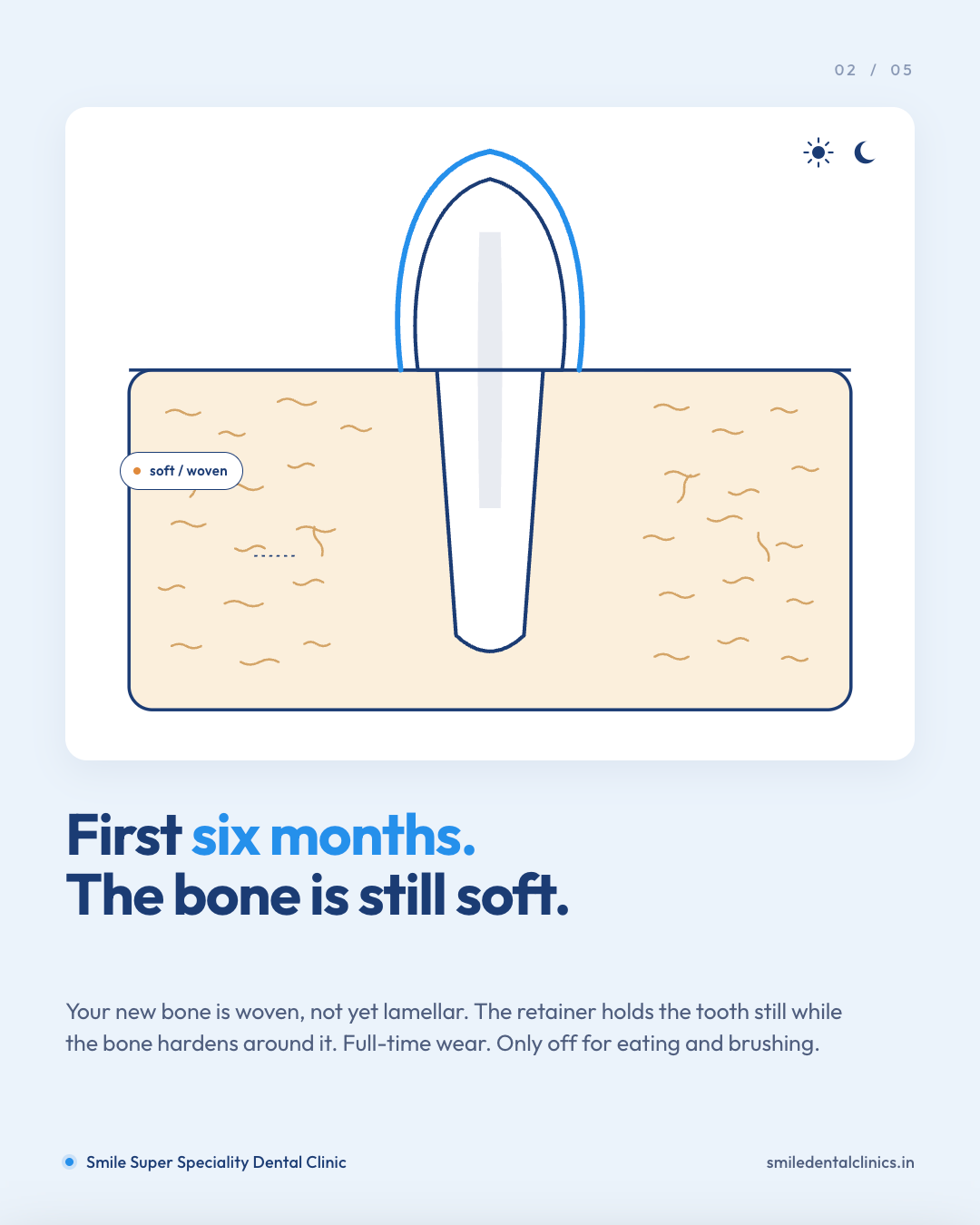
The new bone is soft. The bone built behind each moving tooth during treatment is called woven bone. It forms fast, which is why teeth move. But woven bone is disorganized and weak. It takes months to be replaced by lamellar bone, which is dense, organized, and strong enough to permanently hold a tooth in place.
For the first several months after braces come off, your teeth are sitting in soft bone, surrounded by stretched gum fibers, with nothing but a retainer keeping them in position.
This is the window where most relapse happens. Skip a few nights, the teeth start drifting. Skip a few months, the visible result starts to unwind. Skip the retainer entirely, you're back where you started, just poorer.
How long until the new bone actually hardens
The most active remodeling happens in the first 3 to 6 months after treatment ends. By the end of a year, the bone is structurally stable in most cases. The gum fibers can take longer.
This is why our retention protocol at Smile Dental is tiered:
First 6 months: full-time retainer wear, other than eating and brushing. This is the non-negotiable window.
Months 6 to 12: nights only.
Year 1 onward: nights, indefinitely.
The indefinitely part trips people up. The honest reason is biological. Teeth naturally drift through life. Faces continue to change subtly into your 30s, 40s, and beyond. A nightly retainer is the smallest possible insurance against undoing years of treatment.
What this means for your treatment at Smile Dental
Orthodontic treatment isn't a one-time service you buy. It's a clinical relationship that runs from initial assessment to the day you stop needing the retainer. For most patients, that day never quite arrives.
At our Visakhapatnam clinic, Dr. Rajesh Kumar Y has been planning orthodontic cases since 1997. MDS in Orthodontics and Dentofacial Orthopedics, with a German fellowship in implantology. 98% of patients arrive on a referral from someone we've treated before.
At Kondapur, Dr. Varsha leads orthodontic assessments and works with patients across HITEC City, Madhapur, Gachibowli, and the broader Kondapur catchment.
Across both branches, the retention window is written into the original treatment plan. You'll know what kind of retainer you need, how long you'll wear it, and what it costs before treatment starts. Not after.
If you've been quoted by a clinic that doesn't talk about retention with the same precision they talk about treatment, that's a signal worth taking seriously.
Book an orthodontic consultation at Smile Dental
You'll get a full assessment, a written treatment plan, and clear cost ranges before any decisions get made. Retention is planned in from day one.
Kondapur (Hyderabad): Dr. Varsha leads orthodontic assessments.
Visakhapatnam: Dr. Rajesh Kumar Y, MDS Orthodontics, since 1997.
Braces at Smile Dental Kondapur cost ₹50,000 to ₹1,50,000 for both jaws. What the fee covers, what moves the number, and how the ₹500 scan consultation gives you an exact price.
A tooth that is cracked or broken down raises one question. Keep it with a root canal and crown, or replace it with an implant? Here is how that call is actually made, and what we check first.
{"@context":"https://schema.org","@graph":[{"@type":"Article","headline":"How Braces and Aligners Actually Move Your Teeth (And Why Retention Decides If It Lasts)","image":"https://cdn.prod.website-files.com/65cf5a365061f64fa8a9cafe/6a38a5c1485e02f0363af129_6a0472216e4f6fc77d077d60_Screenshot%25202026-05-13%2520at%25205.46.14%25E2%2580%25AFPM.png","author":{"@type":"Person","name":"Dr. Y. Rajesh Kumar"},"publisher":{"@type":"Organization","name":"The Smile Super Speciality Dental Clinic","logo":{"@type":"ImageObject","url":"https://cdn.prod.website-files.com/65cf5a365061f64fa8a9cac0/662412439ff1555130de7313_High%20res%20logo-PNG%20copy.avif"}},"datePublished":"2026-05-22","dateModified":"2026-07-04","mainEntityOfPage":"https://www.smiledentalclinics.in/blog/how-braces-and-aligners-move-teeth","inLanguage":"en"},{"@type":"FAQPage","mainEntity":[{"@type":"Question","name":"How long does it take to straighten teeth with braces or aligners?","acceptedAnswer":{"@type":"Answer","text":"Most cases take 12 to 24 months. Mild crowding can resolve in 6 to 9 months with aligners. Complex cases involving bite correction or impacted teeth may need 24 to 36 months. Your treatment plan should specify the timeline before you start."}},{"@type":"Question","name":"Do teeth really move back after braces?","acceptedAnswer":{"@type":"Answer","text":"Yes, if you don't wear your retainer. The bone holding teeth in their new position stays soft for several months after treatment ends. The gum fibers that connected your teeth to their old positions take even longer to remodel. Without a retainer, both of these biological factors pull teeth back toward their original alignment."}},{"@type":"Question","name":"How long do I need to wear my retainer?","acceptedAnswer":{"@type":"Answer","text":"Full-time for the first 6 months. Nights for the next 6 months. Then nights indefinitely. Teeth shift naturally through life, so most orthodontists now recommend lifelong nighttime retainer wear to protect treatment results."}},{"@type":"Question","name":"Why does my orthodontist say light force is better than strong force?","acceptedAnswer":{"@type":"Answer","text":"Heavy force compresses the blood vessels inside the periodontal ligament so severely that the tissue undergoes hyalinization, a temporary cellular shutdown. Tooth movement halts until the body clears the damaged tissue. Light continuous force keeps the biology running smoothly, which produces faster overall results."}},{"@type":"Question","name":"Are clear aligners as effective as traditional braces?","acceptedAnswer":{"@type":"Answer","text":"For mild to moderate cases, yes. For complex bite corrections, severe rotations, or cases involving children still growing, traditional braces are usually more predictable. Your orthodontist's case by case judgment matters more than any blanket statement about either system."}},{"@type":"Question","name":"Can adults still get braces or aligners?","acceptedAnswer":{"@type":"Answer","text":"Yes. Adult bone remodeling is slower than in children, so treatment may take slightly longer, but the underlying biology is the same. Adults often prefer aligners for visibility reasons during professional life."}},{"@type":"Question","name":"What happens if I lose my retainer?","acceptedAnswer":{"@type":"Answer","text":"Replace it immediately. Even a week or two without retention in the first year can cause noticeable shifting. Most clinics, including Smile Dental, can produce a replacement within a few days from your original treatment records."}},{"@type":"Question","name":"What's the difference between a fixed retainer and a removable one?","acceptedAnswer":{"@type":"Answer","text":"A fixed retainer is a thin wire bonded to the back of your front teeth. It works 24 by 7 without requiring you to remember anything, but it requires careful cleaning. A removable retainer (Hawley wire or clear Essix) is easier to clean but only works when you wear it. Many patients use both."}}]}]}



.png)
.png)
.png)