You sit in the chair. Mouth open. Your orthodontist looks, prods, tightens something, maybe changes a wire. Ten minutes. You leave.
What just happened?
Most people figure their orthodontist checked whether teeth moved enough. Tightened things up. Kept the schedule on track.
That's a fraction of it.
There's a tissue in your mouth you've never heard of
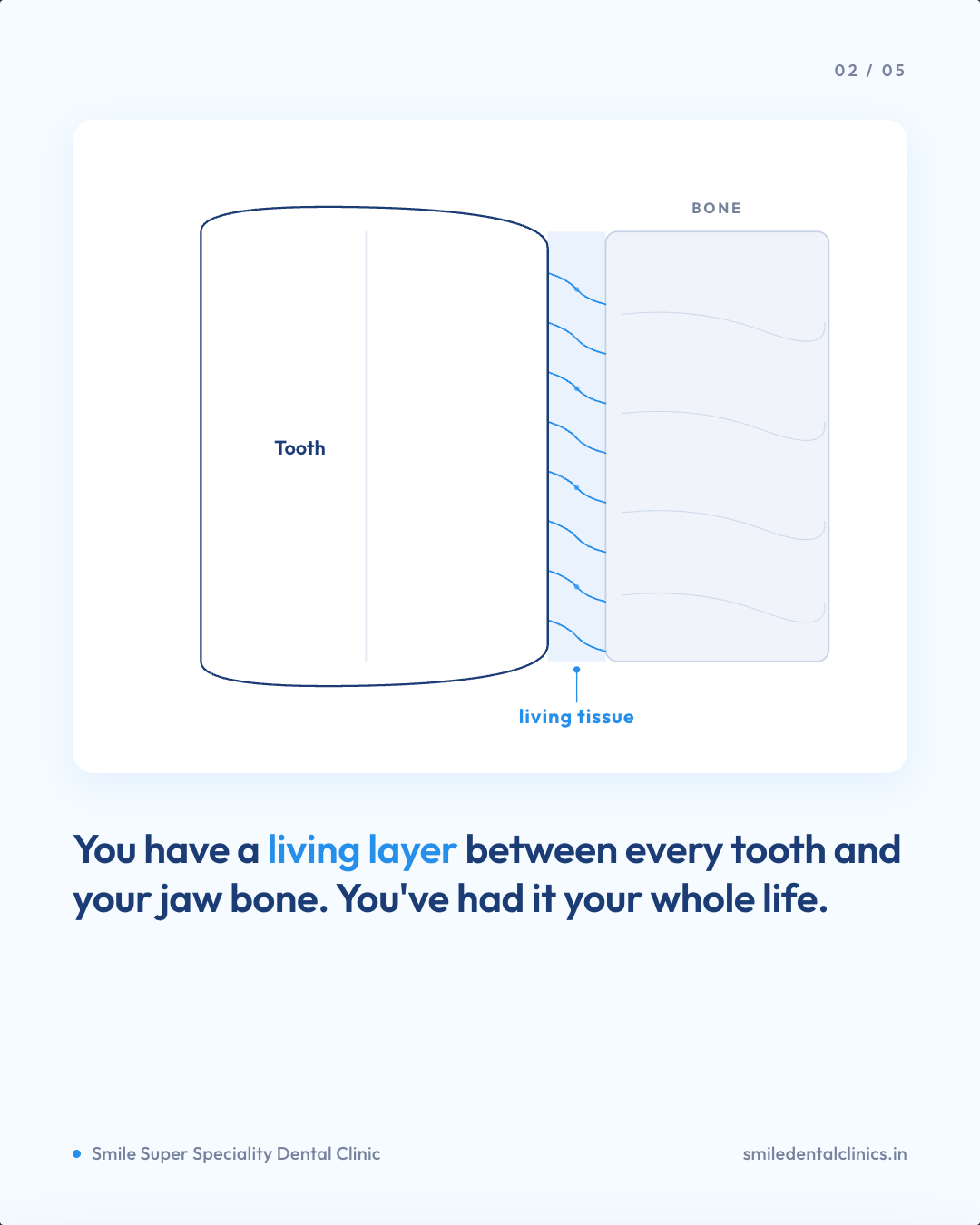
Between every tooth root and the bone it sits in, there's a thin layer of living tissue. Wraps around the entire root like a sleeve. You've had it since your teeth came in. Never felt it. Probably never will.
Dentists call it the periodontal ligament.
Not just padding. This tissue is alive — blood vessels, nerve endings, and cells that can sense pressure. Genuinely sense it, the way your fingertip feels a surface.
When something pushes on a tooth, this ligament is the first thing that responds.
What happens when braces push
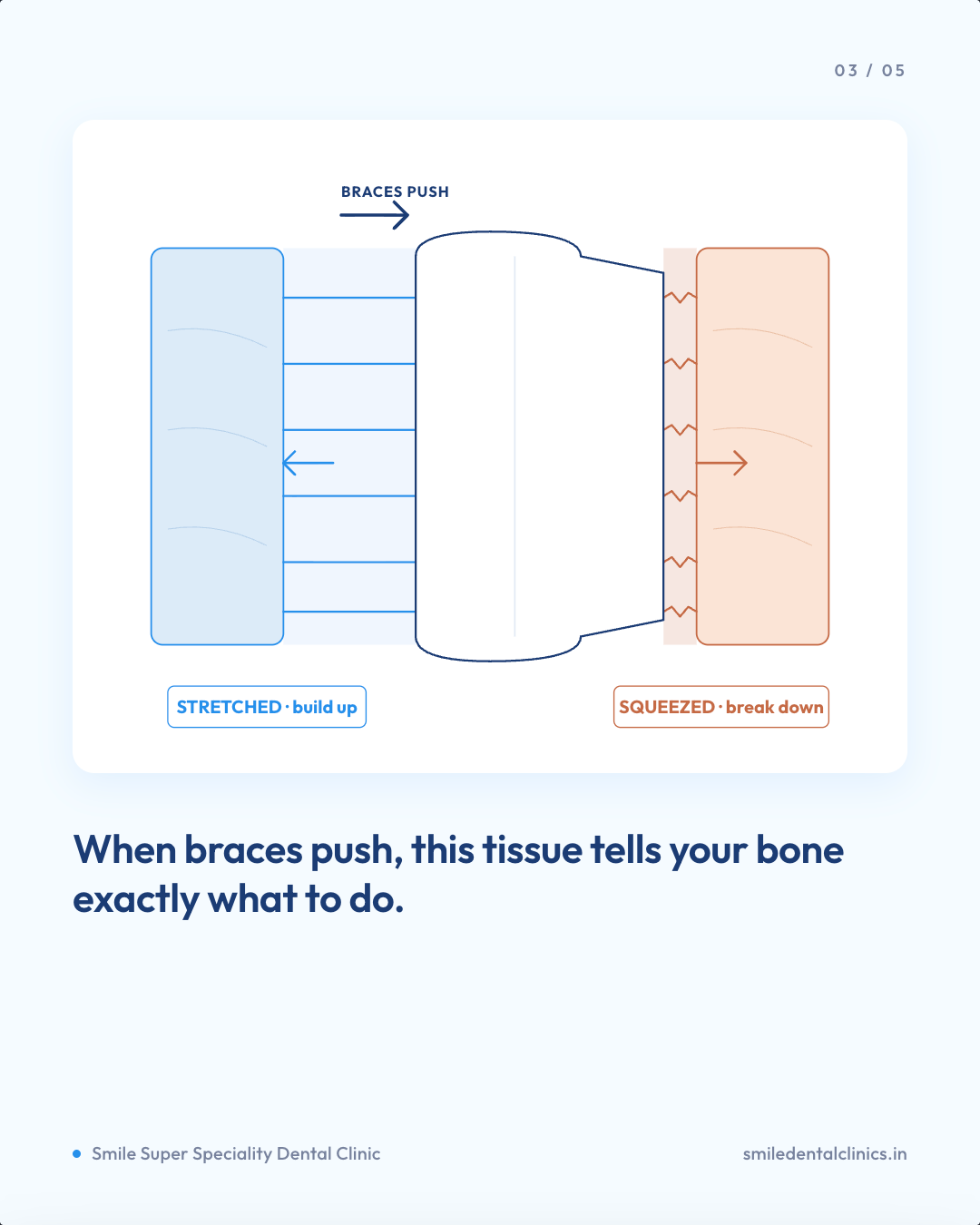
When braces apply force, the ligament gets squeezed on one side of the tooth. The side being pushed toward. On the other side, it gets stretched.
Each side sends a completely different signal.
The squeezed side tells nearby bone cells: break down. Make room.
The stretched side tells different cells: build. Lay down new bone. Fill the gap.
Same tissue. Two opposite instructions. Running at the same time.
The ligament is translating mechanical force into biological signals that reshape your jaw bone in real time.
Why your orthodontist obsesses over force
This is the part nobody explains to patients.
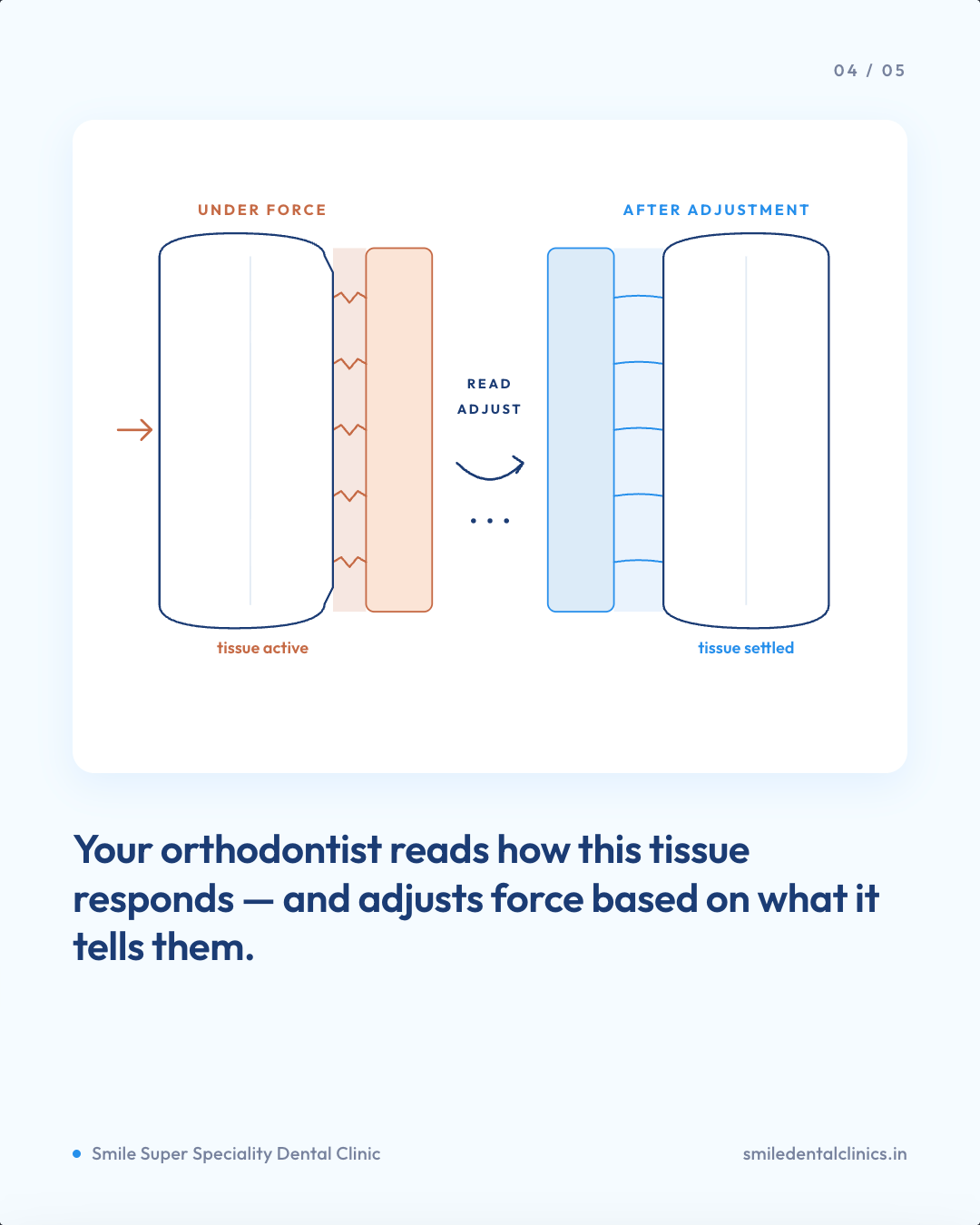
The ligament only works if it stays alive. Light, steady force — it responds beautifully. Signals fire. Bone remodels. Tooth moves.
Too much force? The tissue on the compressed side dies. Just dies. A small patch goes necrotic. Orthodontists call this hyalinisation.
When that happens, everything stalls. The tooth stops moving entirely while your body clears the dead tissue. Could be weeks of zero progress. And if the damage is bad enough, your roots can shorten permanently.
So when your orthodontist spends time checking, adjusting, sometimes barely changing anything — they're not being slow. They're keeping this tissue alive.
Proof that it matters
Some teeth fuse directly to bone. No ligament in between. It's called ankylosis — happens sometimes after trauma or with certain baby teeth that don't fall out on schedule.
Braces cannot move these teeth. At all. Apply all the force you want. Nothing. Because the control system isn't there.
That's how much this one tissue matters. Without it, orthodontics doesn't work.
What this means when you're choosing an orthodontist
Every appointment, your orthodontist is doing something you can't see or feel. They're assessing how this ligament responds. Whether the force is too much. Whether bone is remodeling on schedule. Whether to push harder, back off, or wait.
That's not a checklist. It's clinical judgement built over years in the chair.
Dr. Rajesh Kumar has been doing this for 33 years at Smile Super Speciality Dental Clinic. MDS in Orthodontics. Fellowship in Implantology from Germany. But honestly — the credential that matters most here is time. Thirty-three years of watching how this tissue responds in thousands of different mouths.
If you're considering braces or aligners, the first step is a clinical evaluation. Your bone, your bite, your ligament health. Not a sales pitch.
Braces at Smile Dental Kondapur cost ₹50,000 to ₹1,50,000 for both jaws. What the fee covers, what moves the number, and how the ₹500 scan consultation gives you an exact price.
A tooth that is cracked or broken down raises one question. Keep it with a root canal and crown, or replace it with an implant? Here is how that call is actually made, and what we check first.
{"@context":"https://schema.org","@graph":[{"@type":"Article","headline":"What Your Orthodontist Is Actually Doing That You Can't See","image":"https://cdn.prod.website-files.com/65cf5a365061f64fa8a9cafe/6a38a5c2485e02f0363af135_69fd81710bb5b86c7d74aa1d_1.png","author":{"@type":"Person","name":"Dr. Y. Rajesh Kumar"},"publisher":{"@type":"Organization","name":"The Smile Super Speciality Dental Clinic","logo":{"@type":"ImageObject","url":"https://cdn.prod.website-files.com/65cf5a365061f64fa8a9cac0/662412439ff1555130de7313_High%20res%20logo-PNG%20copy.avif"}},"datePublished":"2026-05-06","dateModified":"2026-07-04","mainEntityOfPage":"https://www.smiledentalclinics.in/blog/what-your-orthodontist-does-you-cant-see","inLanguage":"en"},{"@type":"FAQPage","mainEntity":[{"@type":"Question","name":"What sits between a tooth and the bone around it?","acceptedAnswer":{"@type":"Answer","text":"A thin living tissue called the periodontal ligament wraps around every tooth root. It has blood vessels, nerve endings, and pressure-sensing cells. It connects the tooth to the jaw bone and acts as the control system for orthodontic movement."}},{"@type":"Question","name":"Can braces work without this ligament?","acceptedAnswer":{"@type":"Answer","text":"No. Some teeth fuse directly to bone, a condition called ankylosis. These teeth have no ligament layer. Braces cannot move them regardless of how much force is applied. The ligament is essential for orthodontic tooth movement."}},{"@type":"Question","name":"How does the orthodontist know how much force to use?","acceptedAnswer":{"@type":"Answer","text":"By monitoring how the periodontal ligament responds over time. Too little force and nothing happens. Too much force and the ligament tissue dies, stalling all movement. The right amount keeps the tissue alive and bone remodeling steady. This judgement develops over years of clinical experience."}},{"@type":"Question","name":"Can too much orthodontic force damage this tissue?","acceptedAnswer":{"@type":"Answer","text":"Yes. Excessive force causes a patch of the ligament to die, which orthodontists call hyalinisation. Movement stops while the body clears the dead tissue. In severe cases, it can also cause permanent root shortening called root resorption."}},{"@type":"Question","name":"Why does orthodontic treatment take so long?","acceptedAnswer":{"@type":"Answer","text":"Because the ligament can only handle so much force at a time without damage. Each adjustment triggers a bone remodeling cycle that takes weeks. The orthodontist works within the biological limits of this tissue, pushing enough to create movement, not so much that it shuts down."}}]}]}