Last month, a mother brought her 8-year-old in for what she thought was a routine checkup. The child had slightly overlapping front teeth. The mother pointed across the room at her husband: "He had the same. It runs in the family."
She wasn't wrong to think that. But when we looked more closely — the narrow jaw, the habitual mouth breathing, the snoring her husband mentioned almost as an afterthought — the picture was more specific than genetics.
In that last two weeks, we saw three other children with almost identical presentations. Different families, different genes, same diet, same habits, same outcome.
What parents often dismiss as "just how kids are"
Crowded teeth and mouth breathing in children have become so common that most parents treat them as defaults. Something children just have, like a preference for screens or an aversion to vegetables.
They're not defaults. They're signals.
The signs worth paying attention to:
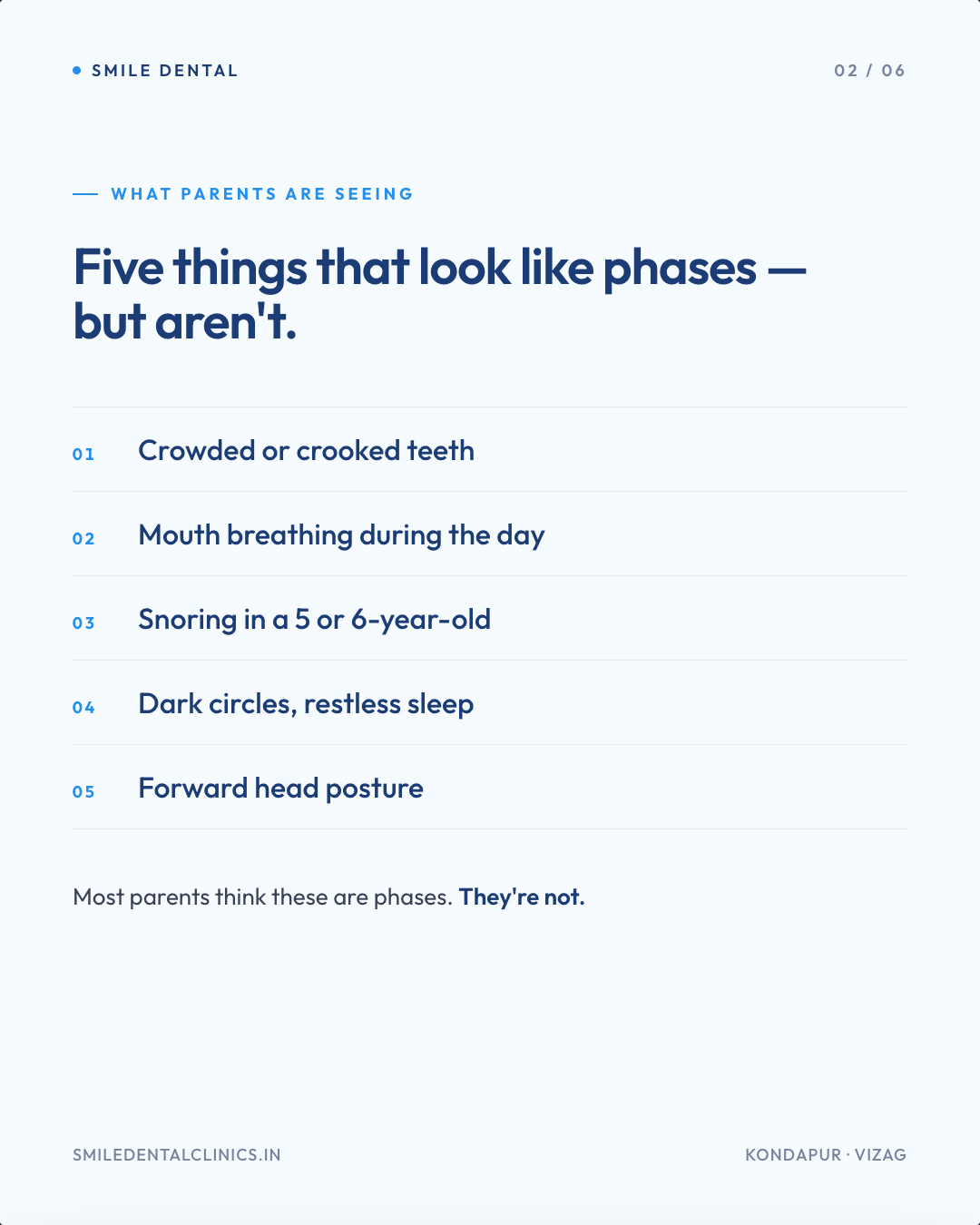
Crowded or overlapping teeth, especially as adult teeth start coming in
Mouth breathing during the day — mouth consistently open when the child isn't sick
Regular snoring, not just during a cold or allergy flare
Dark circles under the eyes or restless, unrefreshing sleep
Forward head posture developing gradually over time
Individually, any one of these might not mean much. Together, they point to one specific place: jaw development.
The jaw growth window most parents don't know about
Between ages 7 and 14, a child's jaw is in its most active growth phase. The midface and mandible grow in response to mechanical stimulation — which is a technical way of saying the jaw grows when it's used.
Chewing hard, fibrous food is the stimulus. Every time a child bites into a whole apple, tears apart a piece of roti, or works through chicken on the bone, it sends a mechanical signal to the jaw. The jaw adapts. It grows forward and wide. Adult teeth come in with room to arrange themselves.
When that stimulus isn't there — when every meal is soft and every snack dissolves without effort — the jaw doesn't get the signal. It stays narrow. The teeth come in crowded because there's nowhere to go.
A narrow jaw also means a narrow airway. That's where the snoring comes from. That's why some children breathe through their mouths during the day. The airway feels restricted, and the body compensates however it can.
This connection between diet, jaw development, and malocclusion has been documented for decades. Sandra Kahn and Paul Ehrlich examined it in Jaws: The Story of a Hidden Epidemic. Dr. Weston A. Price noted the same pattern 80 years earlier when he studied traditional communities that hadn't shifted to processed diets — their children had wide dental arches and rarely needed orthodontic treatment.
What happened to Indian children's jaws in one generation
Think about what Indian grandparents ate as children. Sugarcane chewed directly. Raw guava from the backyard. Rotis with some resistance to them. Roasted chana. Chicken on the bone, worked apart with effort. These weren't health choices — they were just the food that was available. And that food required real chewing.
Now look at what most urban Indian children eat today. Bread. Maggi. Packaged biscuits. Soft idlis. Mashed vegetables. Boneless chicken, often cut into pieces before it reaches the child. Every meal designed for ease. Every snack engineered to dissolve.
The jaw doesn't distinguish between convenient and inconvenient food. It responds to mechanical load. No load, no growth signal.
The result shows up in clinics every single week: 8-year-olds with adult teeth coming in crooked because there's no room, children who habitually breathe through their mouths, kids whose snoring is explained away as a phase while their jaws quietly stay underdeveloped.
This isn't a criticism of how parents feed their children. Soft food is convenient, available, and children genuinely prefer it. The point is simply that chewing effort used to be unavoidable. Now it has to be deliberate.
Foods that help — what to bring back to the table
This isn't about eliminating processed food. It's about making sure hard, fibrous food appears regularly enough that the jaw gets consistent stimulus.
Sugarcane. The original jaw workout. If your child is old enough, chewing sugarcane is one of the most effective natural jaw exercises that exists.
Whole fruits — raw guava, whole apples. Not juice, not puree. Biting into a whole fruit requires real effort. That effort is the point.
Raw carrot and cucumber strips. Cut lengthwise, not into small coins. The longer shape requires sustained bite pressure rather than a single chomp.
Roasted chana. A snack most Indian households already stock. Hard, fibrous, requires real chewing. Simple to introduce.
Bone-in meat. Chicken drumsticks, lamb on the bone. Boneless chicken requires almost no jaw effort. Bone-in portions make the child work in a way that actually loads the jaw.
Harder rotis and bhakri. Not the softest version available. The texture difference matters more than most parents realise.
A few practical notes: cut everything to age-appropriate sizes. Supervise younger children, particularly with anything fibrous or bone-adjacent. This isn't about giving a 4-year-old something they can choke on — it's about ensuring chewing effort is a regular part of eating, not an accident.
When to bring your child in
If your child is between 7 and 14, a jaw and bite assessment is worth doing — not because something is definitely wrong, but because this is the window when the jaw is still growing and intervention is simplest. After growth stops, options narrow considerably.
If you're seeing crowded teeth coming in, consistent mouth breathing, regular snoring, or restless sleep with dark circles, don't wait for the next routine checkup. Come in specifically for a developmental assessment.
At Smile Dental, we look at jaw width, bite alignment, airway space, and breathing patterns. We explain what we find, lay out all the options (including doing nothing and monitoring), and let you make the call. Both our Kondapur (Hyderabad) and Visakhapatnam clinics see pediatric orthodontic cases.
The earlier the assessment, the more options there are. That's the honest reason to act before 14 rather than after.
Braces at Smile Dental Kondapur cost ₹50,000 to ₹1,50,000 for both jaws. What the fee covers, what moves the number, and how the ₹500 scan consultation gives you an exact price.
A tooth that is cracked or broken down raises one question. Keep it with a root canal and crown, or replace it with an implant? Here is how that call is actually made, and what we check first.
{"@context":"https://schema.org","@graph":[{"@type":"Article","headline":"Why Your Child's Crowded Teeth Aren't Just Genetics","image":"https://cdn.prod.website-files.com/65cf5a365061f64fa8a9cafe/6a38a5c1485e02f0363af12d_69ff2f24364b0a4d8face7e2__Users_apple_Downloads_Carousel%252520posts-2%2525202_Carousel-JawDevelopment.html%2520(1).png","author":{"@type":"Person","name":"Dr. Varsha Reddy"},"publisher":{"@type":"Organization","name":"The Smile Super Speciality Dental Clinic","logo":{"@type":"ImageObject","url":"https://cdn.prod.website-files.com/65cf5a365061f64fa8a9cac0/662412439ff1555130de7313_High%20res%20logo-PNG%20copy.avif"}},"datePublished":"2026-05-09","dateModified":"2026-07-04","mainEntityOfPage":"https://www.smiledentalclinics.in/blog/why-your-childs-crowded-teeth-arent-just-genetics","inLanguage":"en"},{"@type":"FAQPage","mainEntity":[{"@type":"Question","name":"At what age should I bring my child for a jaw assessment?","acceptedAnswer":{"@type":"Answer","text":"Between 7 and 10 is ideal, while jaw growth is active and there's the most room to guide development. But if you're seeing concerns in a child younger than 7 or older than 10, still come in. Every child's development timeline is different."}},{"@type":"Question","name":"Is jaw underdevelopment always fixable?","acceptedAnswer":{"@type":"Answer","text":"During the growth window, there's quite a bit that can be done: palate expanders, myofunctional exercises, dietary changes, and in some cases early orthodontics. Once the jaw stops growing, the options change. Early assessment gives you more choices, not fewer."}},{"@type":"Question","name":"Does my child need braces if their jaw is underdeveloped?","acceptedAnswer":{"@type":"Answer","text":"Not necessarily. Some cases respond well to simpler interventions during the growth phase. Others do eventually need orthodontic treatment. An assessment tells you which category your child is in, with specific options and realistic timelines."}},{"@type":"Question","name":"Can changing diet alone fix the problem?","acceptedAnswer":{"@type":"Answer","text":"Dietary changes can support jaw development and stop things from getting worse. If the jaw has already stopped growing or malocclusion is significant, diet alone isn't sufficient. It works best as prevention, or alongside other treatment during the active growth window."}},{"@type":"Question","name":"How do I know if my child is mouth breathing?","acceptedAnswer":{"@type":"Answer","text":"Watch them when they're relaxed, watching TV, reading, or asleep. If the mouth is consistently open and lips aren't together, that's mouth breathing. Other indicators: mouth feels dry on waking, frequent snoring without illness, waking up tired despite enough sleep."}},{"@type":"Question","name":"Is snoring in children always related to jaw development?","acceptedAnswer":{"@type":"Answer","text":"Not always, but it's one of the more common causes in otherwise healthy children. Snoring in a child without a cold or known allergy is worth investigating, particularly when paired with mouth breathing during the day or crowded teeth coming in."}}]}]}





.png)
.png)
.png)
.png)