Do Veneers Damage Your Teeth? What Is Removed, and the Options That Remove Nothing
Do veneers ruin your teeth? What porcelain removes, what bonding keeps, how long each lasts, and the smile fixes that remove no enamel at all.
Read More



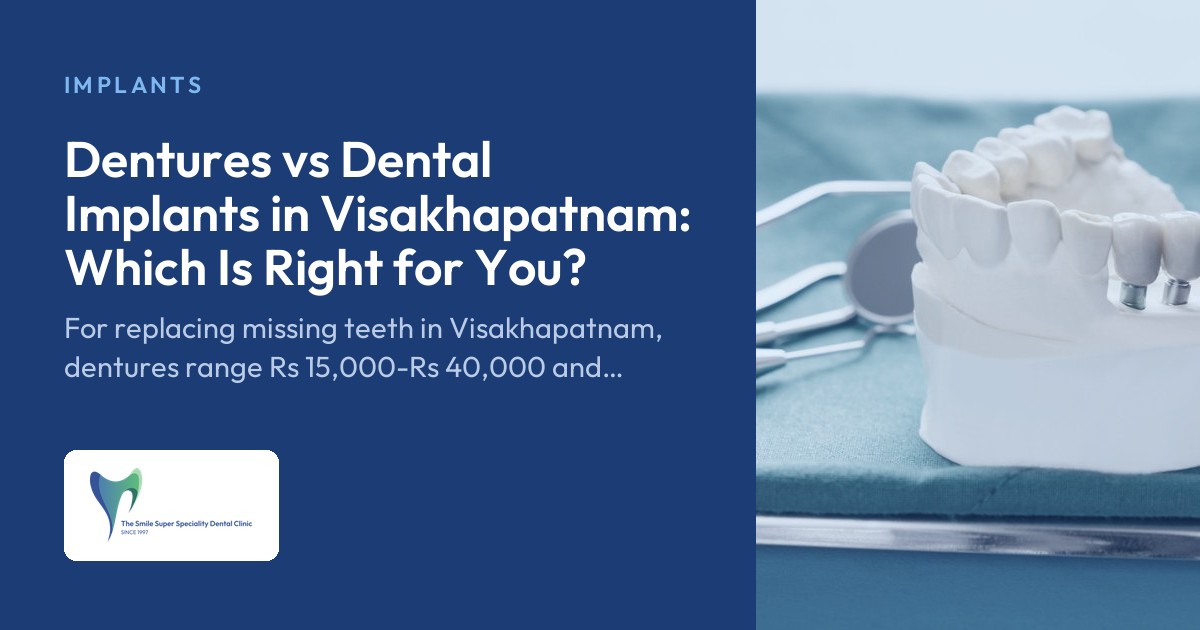


Dentures are the quicker, lower-cost way to replace missing teeth: complete dentures cost ₹15,000 to ₹40,000 per jaw at Smile Dental in Vizag, with no surgery. Implants cost more (₹35,000 to ₹88,000 per tooth with the crown) but stay fixed, feel like your own teeth and can last 20 years or more.
Which one suits you depends on how many teeth are missing, the bone you have and your budget. Prices are the same at our Vizag and Kondapur clinics, and your exact figure is in a written plan after the ₹500 consultation, which includes an iTero 3D scan.
The short version: dentures win on cost and speed, implants win on comfort, chewing and how long they last.
| Dentures | Dental implants | |
|---|---|---|
| Cost | ₹15,000 to ₹40,000 per jaw (complete); ₹10,000 to ₹30,000 (partial) | ₹35,000 to ₹88,000 per tooth with crown; All-on-4 ₹2,50,000 to ₹4,00,000 per jaw |
| Surgery | None | Yes, under local anaesthesia |
| Time to teeth | Usually 1 to 2 weeks | 3 to 6 months for the implant to settle before the final crown (All-on-4 gives fixed temporary teeth sooner) |
| Daily life | Taken out to clean; some foods need care | Fixed; brushed like natural teeth |
| Upkeep | Relining every 2 to 3 years, replacement every 5 to 8 years | Check and clean every 6 months; implants can last 20 years or more |
| Bone | Gums and bone under the denture slowly change shape | The implant works like a root and helps keep the bone |
A denture is a removable set of teeth on a gum-coloured base, and it is the fastest way to get a full smile back without surgery.
Types we make at our Vizag and Kondapur clinics:
Good: lowest cost, no surgery, ready quickly, and a sound choice when health or bone rules implants out.
Trade-offs: they can move with sticky or hard foods, they come out daily for cleaning, sore spots are common in the first weeks, and an upper denture covers the palate, which dulls taste a little. Gums change shape over time, so dentures need relining every 2 to 3 years and replacing every 5 to 8.
More on types and fitting on our dentures page.
An implant is a titanium post placed in the jawbone that carries a crown, a bridge or a full arch, and it stays put when you eat and speak.
Good: you chew normally, nothing comes out at night, taste is unchanged, and the implant helps keep the jawbone. Well-kept implants can last 20 years or more.
Trade-offs: higher cost, a minor surgery, and a few months of healing before the final teeth. You need enough bone (a graft, ₹10,000 to ₹50,000, can build it up), well-controlled diabetes, and careful cleaning around the implants. Smokers are asked to cut down or stop, as smoking slows healing.
See prices by implant system on our dental implants in Vizag and Kondapur page, or the full breakdown in our dental implant cost in Vizag guide.
The cheaper option is listed first in each case, because it is often enough.
One missing tooth
| Option | Cost | Good to know |
|---|---|---|
| Partial denture | ₹10,000 to ₹30,000 | Removable; quickest and lowest cost |
| Fixed bridge (3-unit) | ₹12,000 to ₹35,000 | No surgery; the teeth either side are shaped to hold it; lasts 10 to 15 years |
| Single implant with crown | ₹35,000 to ₹88,000 | Leaves neighbouring teeth untouched |
Two to four teeth in a row
| Option | Cost | Good to know |
|---|---|---|
| Partial denture | ₹10,000 to ₹30,000 | Flexible version ₹20,000 to ₹45,000 |
| Fixed bridge (4 or 5 units) | ₹25,000 to ₹55,000 (4-unit), ₹35,000 to ₹75,000 (5-unit) | Needs strong teeth at each end |
| Implant-supported bridge | In your written plan | Usually 2 implants carrying the teeth between them |
A full jaw
| Option | Cost per jaw | Good to know |
|---|---|---|
| Complete denture | ₹15,000 to ₹40,000 | Removable, no surgery |
| Flexible denture | ₹20,000 to ₹45,000 | More comfortable fit |
| Implant-supported denture | ₹1,50,000 to ₹3,50,000 | Snaps on, does not slip, still comes out to clean |
| All-on-4 | ₹2,50,000 to ₹4,00,000 | Fixed teeth that never come out |
X-rays, if needed, are ₹200 (IOPA) or ₹500 (OPG). For a single gap, our dental bridges page compares a bridge and an implant over 15 years.
For one or two missing teeth, a partial denture (₹10,000 to ₹30,000) usually costs less than a 3-unit bridge (₹12,000 to ₹35,000), but the bridge is fixed and feels more natural.
A bridge suits you if the teeth on both sides of the gap are strong, especially if they already have fillings or crowns. A partial denture suits you if you want the lowest cost, no drilling on healthy teeth, or plan to move to implants later.
Most people can narrow it down with three questions, and the doctor helps with the rest at the consultation.
1. What does your budget allow now, and later? If you need teeth now on a tight budget, dentures are the practical start, and they do not rule out implants later. Over 20 years the gap narrows, because dentures are relined and replaced a few times while a well-kept implant usually is not.
2. How much bone do you have? The 3D scan and an X-ray show it. Enough bone makes implants straightforward; thin bone may need a graft first. Our guide on what to do when there is not enough bone for an implant explains the options.
3. Which matters more: the upfront cost or how it feels every day? If you are fine taking teeth out at night and going easy on some foods, dentures do the job well. If you want to eat anything and forget about it, implants are worth the extra.
If a loose lower denture is the main problem, two to four implants that the denture snaps onto often solve it for less than a fixed arch.
The denture still comes out for cleaning but stays firm when you eat. It costs ₹1,50,000 to ₹3,50,000 per jaw, against ₹2,50,000 to ₹4,00,000 for fixed teeth with All-on-4 dental implants in Kondapur and Vizag. Many people already wearing a denture can have it converted this way.
This guide is written by Dr. Y. Rajesh Kumar (MDS Orthodontics, Facial Orthopedist, Fellow of Implantology, Germany). The Smile Super Speciality Dental Clinic has treated families since 1997, is ISO 9001 certified, and has clinics in Kondapur (Hyderabad) and at Maharani Peta in Vizag.
At the ₹500 consultation you get an iTero 3D scan, the options that fit your mouth side by side, and a written plan with the exact price of each, the implant and crown listed separately. If you already have a quote from elsewhere, bring it; our second opinion guide explains what to look for.
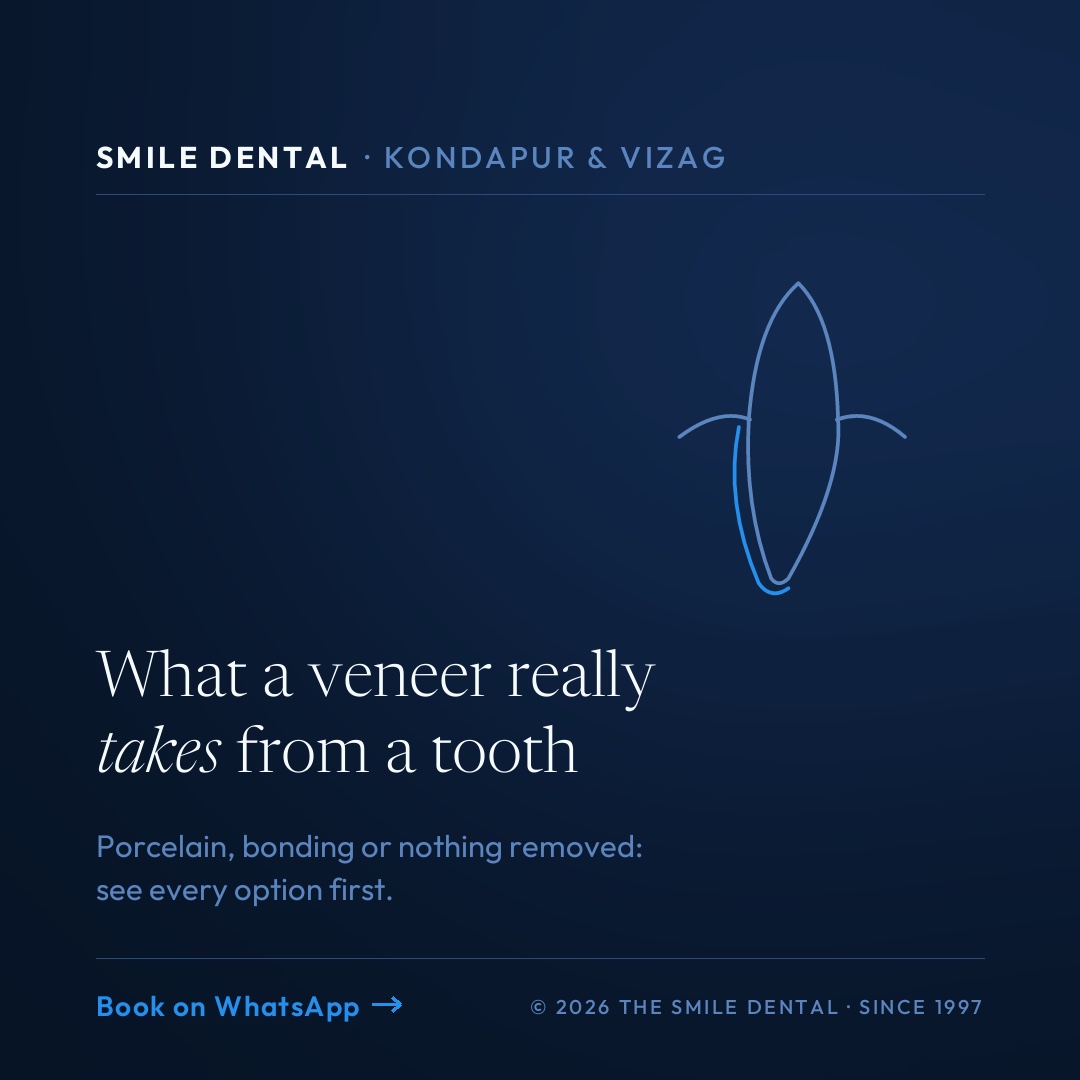
Do veneers ruin your teeth? What porcelain removes, what bonding keeps, how long each lasts, and the smile fixes that remove no enamel at all.

What counts as a dental emergency, what to do in the first 15 minutes, what an emergency visit in Vizag costs (₹1,000 to ₹3,000), Sunday and after-hours advice, and when to go to a hospital instead.