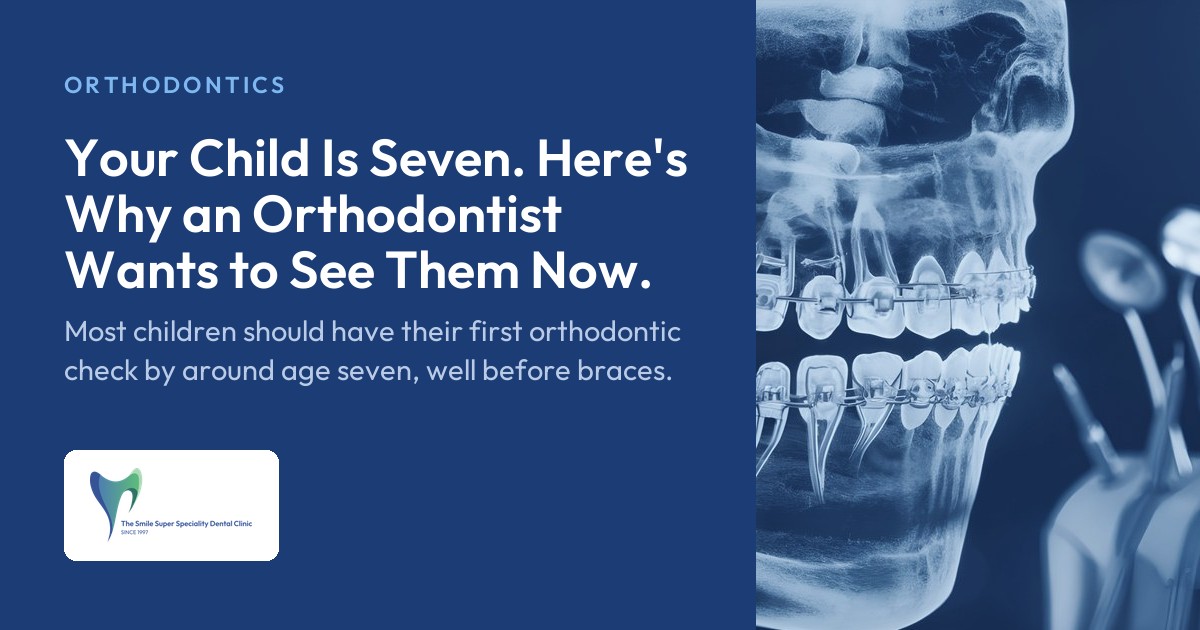
Bring a seven-year-old to an orthodontist and most parents expect one of two replies. Too early, come back when the adult teeth are in. Or the opposite, your child already needs braces.
The honest answer is usually neither.
At this age we're not counting crooked teeth. We're watching how the face is growing. Orthodontics is the part most people know, straightening teeth that have come in wrong. Right beside it sits dentofacial orthopedics, the work of guiding the jaw bones while a child is still growing. Teeth are what you notice in photos. The jaws underneath are what decide whether those teeth ever had room to sit straight to begin with.
That difference is the whole reason we look early.
"He's only seven, it'll sort itself out"
This is the line we hear most, and for plenty of small things it's correct. A baby tooth that's slightly rotated, a little spacing here and there, those often settle on their own as the mouth changes. We're not looking to treat seven-year-olds for the sake of it.
But some problems don't wait politely for thirteen. A narrow upper jaw that's locked stays narrow. A lower jaw sitting too far back doesn't drift forward on its own; growth simply keeps building the face around that position. Run that for a few more years and the face commits to the wrong blueprint. By the time the usual braces conversation starts, you're no longer guiding growth. You're working against a structure that has already set.
What an orthodontist actually checks at the first visit
Most of this has little to do with how straight the front teeth look. A proper early assessment runs through a short checklist, and appearance is the smallest part of it.
How the child breathes. A child who breathes through the mouth most of the day, and especially while asleep, usually has a blocked nose behind it. Enlarged adenoids or tonsils are common culprits. Long-term mouth breathing is linked with a narrower upper jaw and a longer face pattern, partly because the tongue stops resting against the palate where it would normally help widen it. When we see this, the first step is often a referral to an ENT, not an appliance.
How the child swallows. In some children the tongue still pushes forward against the front teeth on every swallow, a habit left over from infancy. That forward push can hold the front teeth apart no matter what else gets done, so it's worth catching while it's still easy to retrain.
Speech and the tongue itself. A tight band of tissue under the tongue, a tongue tie, can limit movement enough to affect both speech and the way the jaw develops. Few parents connect a speech issue to orthodontics, but it belongs in the same room.
The bite. This is the big one. A crossbite is when the upper teeth close inside the lower ones instead of outside them, a reverse of the normal pattern. In a growing child, a crossbite often forces the lower jaw to shift to one side as they close, and the jaw can grow lopsided around that shift. Of everything on the list, a crossbite is one of the clearest reasons to act early rather than wait.
Room for the teeth still to come. A simple X-ray shows whether the jaws are likely to have space for the permanent teeth that haven't arrived yet. Severe crowding spotted at seven or eight can sometimes be eased by guiding the width and growth of the jaw, which lowers the chance of pulling permanent teeth later on.
Why we ask about how your child sleeps
Parents are sometimes thrown when an orthodontist asks whether their child snores or sleeps with the mouth open. The link is real. A child who can't breathe well through the nose tends to keep the mouth open to compensate, day and night, and that resting posture is part of what shapes the upper jaw and the face over years of growth.
It runs the other way too. A narrow upper jaw leaves less room for the nasal airway sitting above it and less room for the tongue below. Widening that jaw at the right age can open up a little more space for both. So when poor sleep, daytime tiredness, or trouble concentrating show up alongside constant mouth breathing, we take it seriously, and it often means working alongside an ENT rather than reaching for an appliance first.
Signs you can notice at home
You don't need a dental degree to spot most of the early flags. It's worth booking a look if your child:
- Breathes through the mouth during the day, or sleeps with the mouth open, snores, or sleeps restlessly
- Still sucks a thumb or finger well past age four or five
- Has front or side teeth that bite the wrong way round, or a jaw that visibly slides to one side when they close
- Loses baby teeth very early or very late
- Struggles to bite or chew, or avoids certain food textures
- Has teeth that look badly crowded or that stick out
None of these mean treatment is certain. They mean a look is worth it.
Why some problems get harder, not easier, with time
A child's jaw cooperates best while it's still growing, and that window doesn't stay open.
Take a narrow upper jaw. While the bones of the palate are still maturing, a small expander can widen it gently over a few months, and the body lays down its own new bone to fill the space. Attempt that same widening after the growth window closes and the simple, non-surgical route is usually gone.
Or take a lower jaw that sits too far back. The look that comes with it, a chin that seems tucked under and a flatter middle third of the face, is partly a growth pattern we can steer while it's forming. Steering it later is a far bigger job.
There's a money side to this as well. A problem caught at seven is usually handled with simple, mostly non-extraction methods. The same problem found at thirteen or fourteen can mean a longer stretch in braces, and sometimes the removal of healthy permanent teeth to make the room that early guidance could have built. Acting early doesn't always mean less treatment in total. What it reliably changes is how hard the eventual problem is to fix.
Early treatment usually doesn't look like braces
Here's the part that surprises parents most. Early orthodontic work on a young child rarely means a mouth full of metal.
Most of it uses small appliances, some removable, some fixed, each doing one specific job. There's the expander that widens a narrow upper jaw. A simple plate can correct a single tooth that's biting the wrong way, or help retrain a tongue that pushes forward. For a lower jaw that sits too far back, a functional appliance encourages it forward using the child's own growth rather than brute force. In certain cases we use an appliance that takes light support from outside the mouth, resting against the forehead or chin, to steer where the jaw is heading.
None of that is the full braces treatment. Think of it as getting the foundation level while the house is still going up. The actual straightening of teeth, if it turns out to be needed at all, comes later, and it tends to be shorter and simpler because the structural part is already handled.
What the first visit is actually like
It's calmer than most parents expect. We look in your child's mouth, watch how the teeth meet, check the bite and the way the jaw moves, and usually take a couple of photos. If something needs a closer look, a single X-ray shows what's happening with the teeth still under the gum. Then we talk.
You leave knowing where things stand. Maybe everything's developing fine and we just want to see your child again in six months. Maybe there's something to keep an eye on, in which case we'll tell you what we're watching and why it isn't urgent yet. Or there's a specific issue worth handling now, and you'll know exactly what it is and what addressing it would involve before you decide anything. Nothing gets started on the spot.
When we'd tell you to wait
Not every seven-year-old who comes in needs treatment. Most don't.
A good early visit often ends with us saying nothing needs doing yet, bring them back in six months so we can watch how things develop. That monitoring is the real point of coming early. We're not hunting for a reason to start. We're looking for the small number of problems that genuinely do better when caught young, and leaving everything else alone until the timing is right.
If anyone tells you your young child needs a full set of braces straight away, that's worth a second opinion. Honest early treatment is targeted. It fixes the one thing that won't wait and leaves the rest for later, when it's simpler to judge what's actually needed.
What to do now
If your child is around six or seven and hasn't had an orthodontic check, this is the age for a first look. Not because something's wrong, but because right now catching a problem early is still easy, and missing one starts to cost you options.
If you've already noticed something, a crossbite, constant mouth breathing, teeth that look badly crowded, a speech issue, don't wait for a milestone birthday to bring it up.
At our Kondapur and Visakhapatnam clinics, an early assessment is a real look at the jaws, the bite, the airway, and the growth still ahead, finishing with a plain explanation of what we see and whether anything needs doing now. If the answer is to wait, we'll say so. When braces or aligners do eventually come into the picture, usually years down the line, that's a separate conversation we're happy to walk you through.
Bring your child in for an early orthodontic check, or just ask us whether the timing is right for them yet.