Do Veneers Damage Your Teeth? What Is Removed, and the Options That Remove Nothing
Do veneers ruin your teeth? What porcelain removes, what bonding keeps, how long each lasts, and the smile fixes that remove no enamel at all.
Read More



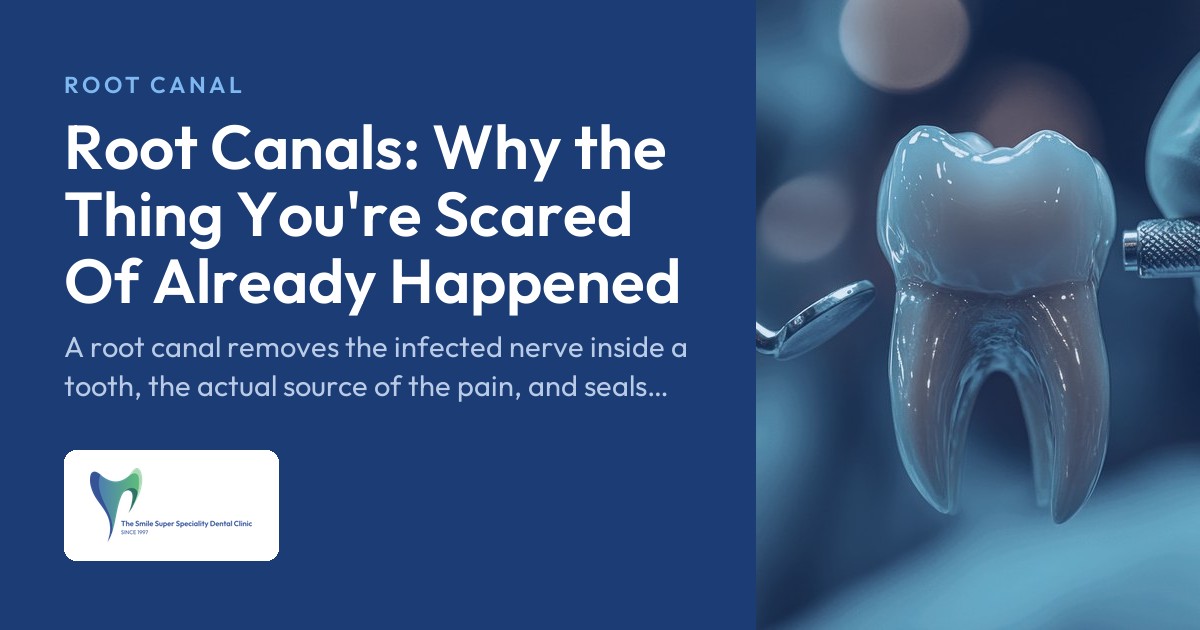


Here is the part nobody tells you. The pain you are dreading from a root canal has, in almost every case, already happened. It is the reason you are in the chair. The throbbing that kept you up, the jaw you could not chew on, the ache that paracetamol stopped touching. That is the infected nerve. The root canal is the thing that takes it out.
So the procedure you are scared of is the one that ends the pain, not the one that causes it.
That single misunderstanding is why so many people sit on an infected tooth for months, hoping it settles, until it abscesses and the choice gets taken out of their hands. This page is here to fix the misunderstanding. What a root canal actually does, why it stopped being the ordeal your uncle remembers, and the one thing about it that decides whether your tooth lasts five years or twenty five.
No. And the gap between the reputation and the reality is enormous.
The dread is a memory of dentistry from decades ago, slow drills, weaker anaesthetic, long appointments. Modern endodontics is a different procedure. The tooth is fully numbed, and most people who have had one done recently describe it as feeling much like a regular filling, just a longer sitting. The discomfort patients report is usually mild and short lived afterward, the kind that settles with ordinary painkillers.
For the first day or two it can feel tender when you bite on it, especially if the infection was significant, and an everyday painkiller covers that easily. Set against the toothache that brought you in, almost everyone finds the treatment itself a relief.
What actually hurts is the infection beforehand. Once the inflamed nerve is removed, that specific pain is gone, often the same day. If you are frightened of the appointment, it helps to remember that you are walking in to switch off a pain, not to start one.
Every tooth is hollow. Inside the hard outer shell is a soft core of nerve and blood vessels, called the pulp, running down through the roots. You can think of it as the living wiring of the tooth.
When deep decay or a crack lets bacteria reach that core, the pulp gets infected and inflamed. Because it is sealed inside a rigid tooth with nowhere to swell, the pressure causes real pain, and left alone the infection spreads out through the tip of the root into the bone, which is what forms an abscess.
A root canal clears that out. The dentist opens the top of the tooth, removes the infected pulp, cleans and disinfects the narrow canals where it lived, and then fills and seals them so bacteria cannot return. The tooth stays. Only the infected inside is taken away. Once a tooth is fully grown, that inner wiring has already done its main job of building the tooth, so capping it off does not make the tooth fall apart. The surrounding gum and bone keep it held in place and supplied, which is why a treated tooth keeps working normally.
Knowing the sequence takes a lot of the fear out of it.
First the tooth and the area around it are fully numbed, so you do not feel the work itself. A thin sheet called a rubber dam is placed to keep the tooth clean and dry and to stop anything reaching your throat. The dentist makes a small opening in the top of the tooth, removes the infected pulp, and uses fine instruments and disinfecting rinses to clean the narrow canals all the way down. The canals are then sealed with a rubber like material, and the opening is closed with a filling. For a back tooth, a crown is fitted at a later visit.
Depending on the tooth and how infected it is, this is done in one or two visits. You can drive yourself home afterward. There is no general anaesthetic and no recovery period the way surgery has one, just a numb lip for a few hours and, sometimes, a day or two of mild tenderness.
No. There is no valid scientific evidence that a root canal treated tooth causes disease anywhere else in the body, and this has been the settled position for a long time.
The fear traces back to a single source. In the 1920s a dentist named Weston Price put forward what he called the focal infection theory, the idea that bacteria sealed inside treated teeth leaked out and triggered illnesses like arthritis and heart disease. His evidence was experiments where he implanted extracted teeth under the skin of rabbits and watched them get sick. By modern standards the work was deeply flawed, with no proper controls and bacterial doses far beyond anything realistic. By the 1930s it had been discredited.
It came roaring back in 2018 through a documentary called Root Cause, which is why patients still ask about it. The American Association of Endodontists has answered it directly. Decades of research contradict the focal infection idea, and there is no valid scientific evidence connecting endodontically treated teeth to systemic disease. The genuine health risk runs the other way. An untreated infected tooth is a live source of inflammation, and clearing it is what protects you, not removing a perfectly restorable tooth out of fear.
Usually not, if the tooth can be saved. Extraction is faster and cheaper on the day, which is exactly what makes it a trap.
When a tooth comes out, the gap does not stay a tidy gap. The teeth on either side tilt into the space, the tooth above or below starts to over erupt, and the bone that used to hold the root begins to shrink. Replacing the tooth properly later with an implant or a bridge usually costs more than the root canal would have, and now you are also paying to manage the drift and bone loss the gap caused. The cheap option turns out to be the expensive one, just on a delay.
There are real exceptions, and we will tell you when you are in one. If a tooth is cracked vertically down into the root, or so broken that there is not enough solid structure left to hold a crown, then a root canal is pouring effort into something that cannot be rebuilt, and a planned extraction with a proper replacement is the honest call. The point is not that we save every tooth. It is that we do not pull a tooth that was worth keeping just because pulling is quicker.
A long time, when it is done well and protected afterward. Long term studies that followed treated teeth found roughly 97 percent still in function at ten years, with success rates around 93 percent, and a large share still serving their owners two and three decades later. These are not fragile, doomed teeth. A well treated root canal is one of the more predictable things in dentistry.
Restoring the tooth well stretches that even further. Teeth capped with a crown after treatment tend to last markedly longer than ones left with only a filling, because the crown does the structural job the missing nerve and the lost tooth material no longer can. But that longevity is not automatic, and it hangs almost entirely on one decision that comes after the canal is finished.
Because a back tooth that has had its nerve removed becomes more brittle, and it is taking the full force of your chewing every day. Without a crown capping it, that weakened tooth is far more likely to crack, and a crack in the wrong place can take the whole tooth past saving. The crown is what stops that.
This is the part where the misunderstanding costs people their teeth. The root canal relieves the pain, the tooth feels completely normal again, and so the crown that was recommended starts to feel optional, an extra expense for a problem that is already gone. It is not optional. For a molar, the crown is part of the treatment, not an add on to it. We see too many teeth that survive the infection and then split months later under a normal bite because they were never covered.
Front teeth, which take far less force, can sometimes do without a crown. Back teeth almost always need one. If a clinic does your root canal and never mentions the crown, that is a reason to ask, not to feel relieved.
Two clinics can quote very different numbers for what sounds like the same procedure, and the reasons are real, not arbitrary. A front tooth has one canal. A molar can have three or four, which is more time and more skill. A tooth that was treated before and is being redone is harder than a first time canal. And the crown that protects a back tooth afterward is a separate, necessary cost that is sometimes quietly left out of the first quote to make the number look smaller. When you compare prices, compare what is actually included. A low figure that does not mention the crown is not really the cheaper option.
Most failures are not the canal going wrong on the day. They come later, and from two directions. One is a tooth that was never crowned, cracking under normal force. The other is bacteria finding their way back in through a leaking filling or fresh decay, re infecting the space that was cleaned. This is why the seal and the final restoration matter as much as the canal work itself.
When a treated tooth does flare up again, it is not automatically lost. A retreatment, where the old material is removed and the canals are cleaned and sealed again, can often save it, and a small surgical procedure at the root tip is a further option. Extraction is the last resort, not the automatic next step. As always, that is a conversation with the scan in front of you, not a default.
The honest signs are persistent pain that does not settle, pain that lingers after something hot or cold, pain on biting, or swelling near a tooth. A scan and a couple of simple tests confirm whether the nerve is involved. As with anything we recommend, you will see the image and hear the reasoning before you agree to a thing, and if the situation can be watched rather than treated, we will tell you that too.
Do veneers ruin your teeth? What porcelain removes, what bonding keeps, how long each lasts, and the smile fixes that remove no enamel at all.

What counts as a dental emergency, what to do in the first 15 minutes, what an emergency visit in Vizag costs (₹1,000 to ₹3,000), Sunday and after-hours advice, and when to go to a hospital instead.