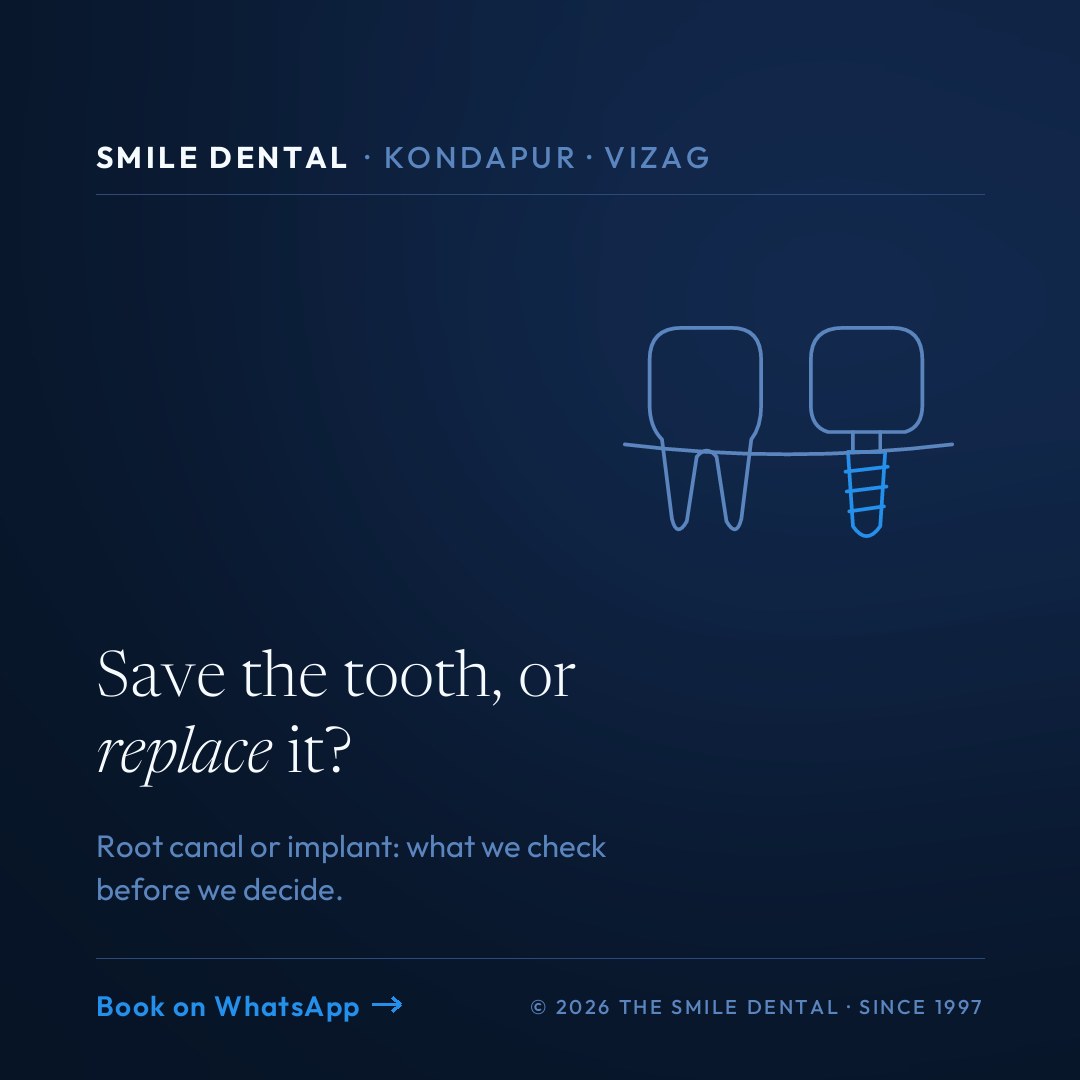
A tooth cracks on something hard, or an old filling gives way, and the question that follows is nearly always the same. Can this tooth be saved, or is it better to take it out and put an implant in its place?
It deserves a real answer rather than a preference. Long term studies put a root canal treated tooth with a well made crown and a single implant in a similar range. Both sit comfortably above ninety percent survival at eight to ten years in careful hands. So the choice does not come from which treatment is better. It comes from the tooth in front of us.
Most teeth in this situation can be kept
That is the starting position, and it is the first thing we test. An implant is a fine piece of engineering, and there are teeth where it is clearly the right call. But a natural tooth has a ligament around its root that senses pressure and cushions your bite. Nothing man made copies that. So the first question is whether the tooth can safely hold a crown. If it can, keeping it is usually the simpler road.
What we look at before we say anything
How much solid tooth is left above the gum
A crown needs a collar of sound tooth to grip. Dentists call this a ferrule. About two millimetres of healthy tooth all the way around gives the crown a long and quiet life. When that collar is there, saving the tooth is the straightforward path. When the tooth has broken away close to the gum line, there is less for a crown to hold, and replacing it starts to look better.
Whether the root itself is sound
A vertical crack running down the root is the finding that most often moves a tooth from the keep column to the replace column. A root thinned by earlier treatment matters too. We look for both on a 3D scan before any decision is made, because this is not something anyone can judge by eye or from a small X-ray alone.
The bone and gum around the tooth
A tooth is held by bone. If gum disease has taken some of that support away, we treat the gums first and look again after. Bone level also tells us something useful about the other route, since an implant needs enough bone to sit in. Where bone is thin, grafting can build it back, and we would explain that as part of the plan rather than spring it on you later.
Where the tooth sits in your bite
A back molar takes the heaviest chewing load, so it needs stronger foundations than a tooth near the front. A front tooth carries the look of your smile, so appearance and gum shape weigh more in that plan. Same question, different answer, depending on the address.
What each route involves
Keeping the tooth: root canal and crown
The root canal itself is usually one or two visits. The tooth is numb throughout and most people find it far calmer than they expected. A crown follows, and we take an iTero 3D scan instead of a mould, so there is no tray of putty. Start to finish you are generally looking at two to three weeks.
Replacing the tooth: extraction and implant
The tooth comes out, and in many cases the implant goes in the same day. Then comes a healing period while the bone locks onto the implant, usually three to four months. The permanent crown goes on after that. Where a graft is needed first, add a few more months. You are not walking around with a gap during this time. A temporary sits in place.
The cost question, looked at properly
On the day, keeping the tooth costs less than replacing it. Over fifteen or twenty years the picture evens out, because a crowned tooth may need attention along the way and an implant crown has its own maintenance. Neither route is something you buy once and forget.
What we can commit to is that you see the number before you agree to anything. Every plan we give is written, itemised, and specific to your mouth. If treatment can be staged over months to make it easier on the wallet, we will say so.
What your first visit looks like
We examine the tooth and take a 3D scan. Then you get a plain answer about what that tooth can carry. If it can be saved, we say so and show you why on the screen. If replacing it is the better option, we show you that too, and you are looking at the same picture we are.
You leave with a written plan. Nothing gets booked unless you want it booked. Dr. Rajesh Kumar Y has been practising for 33 years, and this clinic has been explaining before treating since 1997. A second opinion is welcome here, including on a plan someone else has already given you.
If you are visiting India for a few weeks
Timing matters more for you than for anyone else. A root canal with a crown fits comfortably inside a two to three week trip. An implant does not finish in one visit, but it splits sensibly. The surgical part happens on this trip and the crown goes on when you next come home. Tell us your travel dates at the first appointment and we will build the plan around them.
The short version
Both routes are good. What decides it is how much healthy tooth is left and what the scan shows about the root. Get a look and a scan, take the written answer home, then decide in your own time.