Do Veneers Damage Your Teeth? What Is Removed, and the Options That Remove Nothing
Do veneers ruin your teeth? What porcelain removes, what bonding keeps, how long each lasts, and the smile fixes that remove no enamel at all.
Read More



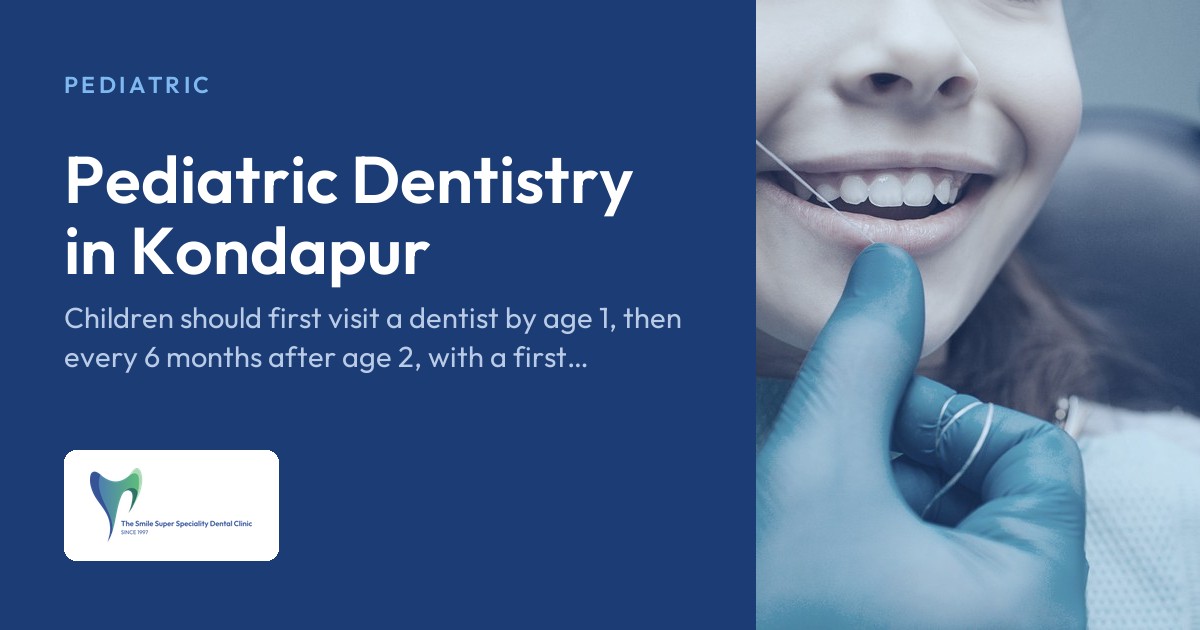


Kids' dental needs are different from adults'. Their mouths are still developing, their anxiety is real, and their long-term dental health depends heavily on what happens in the first decade of life. This guide covers what to expect at each age, what problems to watch for, when to bring your child in, and what treatments we provide at Smile Dental Kondapur.
Dr. Varsha sees children from infancy through adolescence. Our approach is straightforward: no restraints, no sedation unless absolutely necessary, take time, explain everything, and never shame a child for being scared.
Earlier than most parents think. The American Academy of Pediatric Dentistry and the Indian Society of Pedodontics both recommend:
First visit by age 1: or within 6 months of the first tooth erupting, whichever comes first. This isn't about treatment; it's about catching early problems (nursing cavities, late eruption, tongue tie) and getting the child comfortable with a dental chair before anything becomes urgent.
Every 6 months after age 2: routine checkups catch cavities when they're still small enough to treat with simple fillings. Cavities in baby teeth progress fast; a small spot can become a painful abscess in 3-4 months.
Age 7: first orthodontic check: not every child needs braces at 7, but that's when crossbites, severe crowding, and jaw growth issues are easiest to spot and cheapest to correct. Early intervention sometimes eliminates the need for extractions later.
Ages 0-3: Infant oral care: Examination for proper tooth eruption, nursing-related cavity prevention, tongue or lip tie assessment. First cleaning if needed at age 2-3 (very gentle). Parent education on brushing technique.
Ages 4-8: Mixed dentition (baby teeth + early permanent teeth): Cleanings, fluoride application, sealants on newly erupted permanent molars (prevents cavities in the deep grooves), cavity fillings, early orthodontic assessment. This is the age where most cavity problems appear.
Ages 9-13: Transition to permanent teeth: Continued cleanings, orthodontic treatment if indicated (interceptive braces, growth modulators, or space maintainers), treatment of sports injuries, night guards for grinders.
Ages 14-17: Adolescent care: Wisdom tooth monitoring (X-rays, decision on extraction timing), braces or aligner completion, whitening if requested (only after all permanent teeth are fully in), habit correction (nail biting, pen chewing, etc.).
Full orthodontic treatment (braces/aligners) costs are the same as adult pricing. See our orthodontics guide for details.
Bring your child in promptly if you see:
A few things we do routinely:
First visit is just a tour. No treatment, no X-rays. Meet Dr. Varsha, ride up and down in the chair, see the tools, ask questions. Second visit is when we examine. By then the environment is familiar.
We use plain English. "The tooth vitamin" instead of fluoride. "Mr. Thirsty" for the suction. "The tooth counter" for the explorer probe. It sounds silly, but it removes a lot of the fear.
No surprises. Every step is explained before it happens. "I'm going to count your teeth now. Open wide and close when you're tired. You're in charge."
Parent in the room. You're welcome to stay with your child. Some children are calmer with parents present; some are calmer without. Your call.
We don't shame. If your child cries or refuses, we pause, chat, and try again, or reschedule. No dragging, no bribes, no tears. Children remember first dental visits for life.
Three reasons we hear repeatedly. First, no rush: pediatric visits are scheduled with extra time so Dr. Varsha isn't clock-watching. Second, honest recommendations: we'll tell you when a baby tooth cavity can be monitored versus when it needs treatment, not push unnecessary treatment. Third, clear home-care coaching so problems don't come back.
Covered in the FAQ section below.
Do veneers ruin your teeth? What porcelain removes, what bonding keeps, how long each lasts, and the smile fixes that remove no enamel at all.

What counts as a dental emergency, what to do in the first 15 minutes, what an emergency visit in Vizag costs (₹1,000 to ₹3,000), Sunday and after-hours advice, and when to go to a hospital instead.