Somewhere along the way, clear aligners stopped being described as what they are, a tool, and started being sold as an upgrade. Invisible. Faster. Better. The grown up choice. Braces, by contrast, got quietly framed as the old, clunky option you settle for.
That framing is marketing, not dentistry. And believing it is how people end up with the wrong treatment for their teeth.
Here is the honest version, the one an orthodontist will give you with the scan up on the screen. Aligners and braces are two different instruments that are good at different jobs. Choosing between them is a clinical decision about your bite, not a lifestyle preference, and not a question of which one is more sophisticated. This page walks through what each actually does well, what aligners genuinely cannot do, and the one thing about straightening teeth that almost nobody tells you until it is too late.
Are clear aligners better than braces?
Neither is better in the abstract. They are different tools for different problems, and the research has been consistent on this for years.
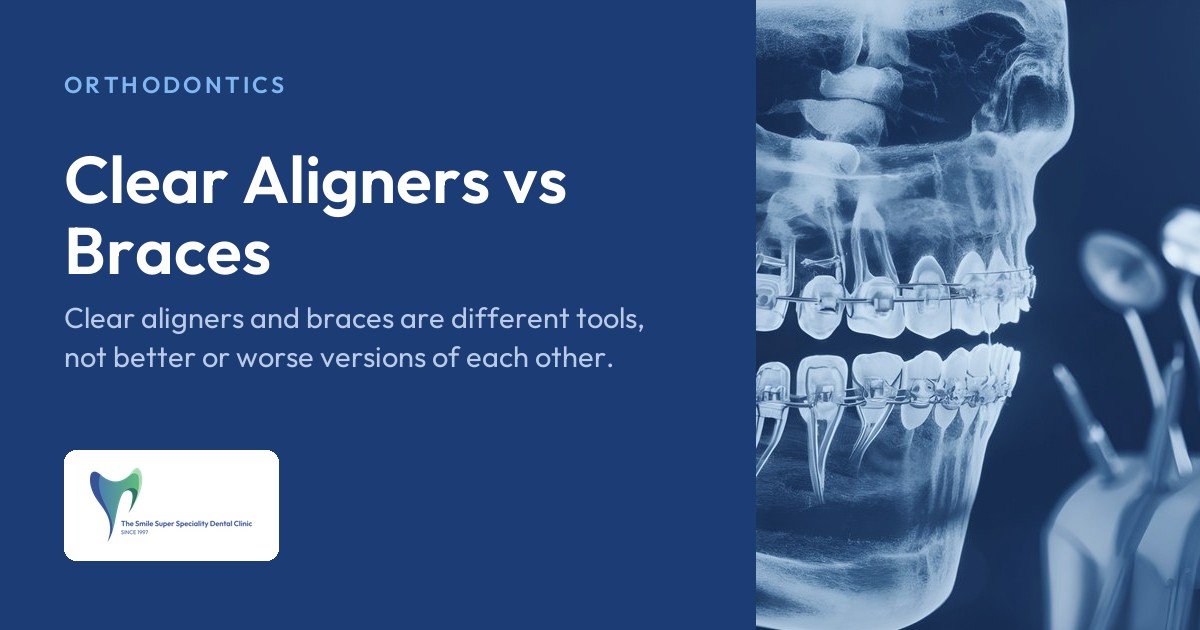
Clear aligners are well suited to mild and moderate cases, crowding and spacing that is not severe. They are more comfortable, far less visible, and easier to keep clean because you take them out to brush. For the right case, the result is excellent.
Braces stay ahead where the movements get hard. Systematic reviews comparing the two find that fixed braces are more effective and more predictable for complex malocclusion, and better at the fine details, getting the upper and lower teeth to meet properly, controlling the angle and the roots of the teeth, and holding the result. That is not nostalgia for old technology. It is mechanics. A bracket bonded to a tooth can push and twist it in ways a plastic shell cannot match yet.
So the honest answer to which is better is really another question. Better for what, and for whose mouth.
Are aligners faster than braces?
Sometimes, for simpler cases. Not as a rule.
For mild to moderate problems, studies have found aligner treatment can run shorter than braces. But that advantage shrinks or reverses as cases get more complex, where braces are usually the more efficient way to reach a precise result. And there is a condition the whole timeline depends on. You have to wear the aligners 20 to 22 hours a day, every day. Take them out too often, leave them out too long, and the teeth do not move on schedule, whatever the original plan promised.
This is the part worth being honest with yourself about. Braces work whether you are disciplined or not, because they are fixed on. Aligners only work if you actually wear them. The speed is not in the brand on the box. It is in your case and your consistency.
What can aligners not do well?
It helps to know the edges of a tool before you choose it.
Aligners are weakest at the hardest movements. Rotating a badly twisted tooth. Closing large gaps from extractions while keeping the roots upright. Making big corrections to how the bite closes. The evidence shows they deliver less reliable results than braces in exactly these situations, and they are less consistent at producing a tight, even bite across all the teeth. The plastic moves the visible crown well but has a harder time controlling the root underneath.
None of this makes aligners bad. It means they have a lane. A clinic that tells you aligners can do absolutely anything, for any case, is selling, not diagnosing. A good orthodontist will tell you plainly when your case sits outside what aligners do best, and will not dress up a compromise as a free choice.
Is having straight teeth the same as having a healthy bite?
No. And of everything on this page, this is the distinction that matters most, because it is the one that gets quietly skipped.
Teeth can look perfectly straight from the front while the bite is still wrong, meaning the upper and lower teeth do not meet the way they should when you close. A bad bite is not a cosmetic detail. It grinds teeth down unevenly, loads the jaw joint, and sets up problems that surface years later as worn, cracked, or aching teeth.
This is where a lot of quick, cheap straightening goes wrong. It lines up the six teeth at the front that show when you smile, declares success, and leaves the bite untouched. The photo looks great. The mechanics underneath are no better, and sometimes worse. Real orthodontic treatment is judged by how the whole bite functions, not by how the front looks in a mirror.
We turn down work like this more often than people expect. Someone comes in wanting only the front teeth nudged for a wedding or a photo and asks us to ignore the bite to keep it quick and cheap. If straightening just the front would leave the bite worse, we say so, and we explain why, even when it is not the answer they walked in hoping for. Lining teeth up for a camera is not the same as treating them.
Why do you have to wear a retainer forever?
Because teeth never fully settle down. They keep a lifelong tendency to drift back toward where they started, which orthodontists call relapse. It is not a sign anything went wrong. It is simply how teeth behave.
A retainer is what holds the result against that drift. Whether you finished with braces or aligners, the moment you stop wearing your retainer the slow creep back begins, and a few years of neglect can undo a couple of years of treatment. Aligners, for what it is worth, are slightly less reliable at holding teeth in their new position than braces, which makes the retainer phase matter even more.
So when you weigh the cost and effort of straightening your teeth, factor in the retainer for the long run. It is not an optional extra at the end. It is the part that protects everything you just paid for.
Are mail-order or DIY aligners safe?
They carry real risk, and the risk is not where most people look for it.
The danger is not the plastic. It is what the cheap models skip, a proper diagnosis. Moving teeth means moving the bone and roots they sit in. Do that without first checking the health of the roots, the level of the bone, and the state of the gums, and you can cause damage that is genuinely hard to undo, loosened teeth, roots pushed where they should not go, a bite left worse than it started. There is no dentist in the room to catch a problem while it is still fixable.
When you pay a clinic to straighten your teeth, the trays are the cheap part of what you are buying. The diagnosis, the plan, and someone watching the movement month to month are the expensive part, and they are the part that keeps you safe.
The cases that worry us most are not the ones that come in for treatment. They are the ones that come in after a remote, unsupervised attempt has already moved teeth in the wrong direction, and now we are not straightening teeth, we are repairing a problem that did not need to exist. Undoing that is slower, harder, and more expensive than doing it properly the first time would have been.
How do you decide between braces and aligners?
The same way we decide anything here. We scan, we look at your roots and your bite, not just the front of your smile, and we tell you honestly which tool fits your case. Sometimes both would work and the choice is genuinely yours. Sometimes only one will get you a proper result, and we will say which, and why.
You see the same images we are looking at. The decision is clinical first and cosmetic second, and you will never be steered toward the option that happens to be most profitable for us. If aligners are right for you, brilliant. If they are not, you deserve to be told that before you commit, not after.
Straightening your teeth is worth doing well, and it lasts for decades when it is done right. The tool matters less than the diagnosis behind it and the honesty of the person holding it.