The disease that takes more adult teeth than anything else is the one you cannot feel. That is not a detail. It is the whole problem.
A cavity hurts, so you come in and we fix it. Gum disease does its work in silence, no pain, no obvious alarm, for years, while the bone that holds your teeth quietly disappears underneath healthy looking gums. By the time it announces itself, with a loose tooth or a gum that has pulled back, the damage is often done and cannot be taken back.
After decades of practice, the cases that stay with you are not the dramatic ones. They are the people who had no idea anything was wrong until a tooth they could have kept was past saving. This page is here so you are not one of them. What gum disease actually is, why bleeding gums are a warning and not a nuisance, and the one line in this disease that, once crossed, you do not get to walk back.
Why is gum disease so dangerous if it does not hurt?
Because the absence of pain is precisely what lets it win.
Gum disease is usually painless until it is advanced, which means most people feel completely fine right up until teeth start to loosen. There is no toothache to push them into a chair. So it goes undiagnosed and untreated, and it keeps going. It is the most common cause of tooth loss in adults worldwide, and it earns that title not by being aggressive and obvious but by being quiet and patient.
Think of how backwards that is. The problems that hurt, you treat early, because the pain forces you to. The condition that is actually the leading cause of losing your teeth gives you no such warning. That is why it deserves more of your attention than the problems you can feel, not less.
What is actually happening to your gums and bone?
It starts with plaque, the soft, sticky film of bacteria that forms on your teeth every day. Where it sits along the gumline and is not cleaned away, it irritates the gum and triggers inflammation.
In the early stage, called gingivitis, that inflammation is on the surface. The gums go red and puffy and bleed easily. Nothing has been lost yet. But if the plaque is left to harden into tartar and the inflammation continues, it works its way deeper, and here is the part that matters. Your own body, fighting the infection, begins to break down the bone that anchors your teeth. The gum pulls away, pockets form, and the supporting bone recedes.
Picture the bone as the foundation a house sits on. You can have a perfectly good looking house, walls straight, paint fresh, while the foundation underneath is slowly washing away. For a long time you see nothing. Then one day the structure shifts, and by then you are not doing maintenance, you are dealing with collapse. Teeth work the same way. They can look fine while their foundation is going.
Are bleeding gums normal?
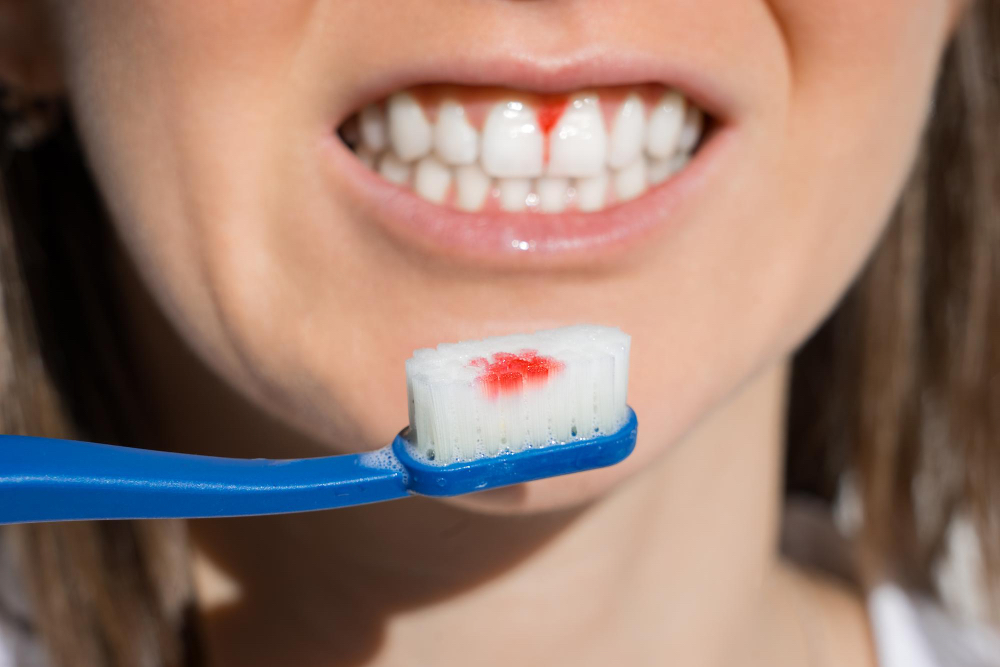
No. This is worth saying plainly, because so many people believe the opposite. Healthy gums do not bleed when you brush or floss.
Bleeding is usually the first visible sign of gum inflammation, which is the earliest and most treatable stage of the disease. It is the smoke alarm. And the common reactions to it, assuming it is normal, deciding you brushed too hard, brushing more gently so it stops, are all ways of silencing the alarm instead of dealing with what set it off.
If your gums bleed regularly, that is information, not an inconvenience. It is the disease in the one phase where it can still be completely reversed, asking you to act while acting still fixes everything.
Can gum disease be reversed?
Partly, and which part can and cannot be reversed is the single most important thing to understand about this disease.
The early stage, gingivitis, is fully reversible. A proper professional cleaning to remove the hardened plaque, followed by good daily brushing and flossing, can return inflamed gums to full health. At this point the disease leaves no lasting mark.
The advanced stage, periodontitis, is not reversible. Once the inflammation has destroyed the bone around your teeth, that bone does not grow back on its own. Treatment can do something vital, it can stop the disease in its tracks and save the teeth that are still anchored, but it cannot rebuild the foundation that is already gone. You can halt the loss. You cannot undo it.
So the entire game is the window. Caught as gingivitis, it is a clean win. Caught as established periodontitis, it becomes a lifelong job of holding the line. The difference between those two outcomes is often just a few years of paying attention, which is exactly why the silent, painless nature of this disease is so costly.
I will be blunt about this, because softening it does not help anyone. In decades of practice I have rarely met someone who was glad they waited. The people who come in at the bleeding-gums stage keep their teeth and barely think about it again. The ones who come in when teeth are already moving are almost always shocked, because it never hurt, and then there is a hard conversation about what we can still save versus what we cannot. This disease is generous with time and merciless about the deadline.
Do you really need a deep cleaning?
This is a fair question, because the honest answer is that it depends, and that both genuine need and unnecessary recommendation exist out there.
A deep cleaning, known as scaling and root planing, is the removal of plaque and tartar from below the gumline, down the surfaces of the roots inside the pockets that periodontitis has created. When there are real pockets and real bone loss, it is not optional, it is the treatment, and skipping it lets the disease keep eating. But it is also a procedure that should not be recommended to someone whose gums are healthy and only need a routine clean above the gumline.
There is a simple way to tell which situation you are in, and you should use it anywhere, not only here. Ask to see your pocket measurements and your X-ray. Gum pockets are measured in millimetres at a check up. Healthy is shallow. Deeper pockets, with bone loss visible on the film, are what justify a deep cleaning. If the numbers and the image support it, the recommendation is sound. If no one can show you either, ask why.
My own rule is straightforward. I would rather measure your gums, show you the pockets, and put the X-ray in front of you than simply book you in for a procedure. If your gums do not need scaling, you will hear that from me. If they do, you will see exactly why on the same screen. A recommendation you can see the evidence for is one you can trust.
Is gum disease linked to other health problems?
It is associated with several, and the link is worth understanding without overstating it. Association means the two tend to travel together. It is not the same as one proving it causes the other.
The clearest connection is with diabetes, and it runs in both directions. Poorly controlled blood sugar makes gum disease worse, and the ongoing inflammation of gum disease can make blood sugar harder to control. The two feed each other. Gum disease has also been associated in research with heart disease, though the exact nature of that relationship is still being worked out.
The practical takeaway is simple and not alarmist. Your gums are not a sealed-off compartment from the rest of you. Chronic infection and inflammation in the mouth are worth taking seriously as part of your general health, particularly if you are diabetic, in which case healthy gums and stable blood sugar are part of the same effort.
How is it treated, and can you keep your teeth?
In most cases, yes, you can keep your teeth, provided you act in time.
Treatment follows the severity. Early gum disease is reversed with a professional cleaning and a genuine improvement in your daily brushing and flossing. Established disease is brought under control with deep cleaning below the gumline, sometimes supported by minor gum procedures where pockets are deep, and then held there with regular maintenance cleanings on a schedule we set with you.
That last part is not a formality. With advanced gum disease the aim shifts from cure to control. There is no finish line where you are done forever, the way a filling is finished. There is a steady routine that keeps the disease switched off and your teeth in your head for the long run. Patients who stick to it keep their teeth. Those who treat it once and disappear tend to come back, with less bone than before.
The signs worth watching are simple. Gums that bleed when you brush. Gums that look red or swollen or have pulled back from the teeth. Persistent bad breath. Teeth that feel even slightly loose. Any of these is a reason to come in, not to wait and see. As with everything we recommend, you will see your own measurements and images, and you will be told honestly which stage you are in and what it genuinely needs.